FREE CONSULTATION: 1-888-760-6552 | [email protected]
Florida Bar Hearing
  • Home
  • About Us
  • Bar Hearing Info
  • Areas of Concern
  • Admission Rules
  • Bar Application
  • After you Apply
  • Blog
  • Contact
  • Menu Menu

Florida Lawyers Assistance Is Closing: Why The Florida Bar Ended Its Funding and What Replaces It

November 13, 2026

After roughly 40 years of helping Florida attorneys with substance abuse, mental health concerns, and other impairments, Florida Lawyers Assistance (FLA) is shutting down. The closure follows The Florida Bar’s decision to end its financial support, and it raises real questions about the future of attorney rehabilitation, monitoring, and confidentiality in Florida.

FLA operated as an independent nonprofit. It assisted attorneys struggling with alcohol dependency, substance abuse, mental health conditions, and other issues that can affect the ability to practice law. Its closure changes how Florida handles attorney impairment, particularly for lawyers who must complete rehabilitation or monitoring as part of a disciplinary proceeding.

Why Is Florida Lawyers Assistance Closing?

The primary reason is funding. FLA reportedly received approximately $700,000 a year from The Florida Bar to operate its programs. The Bar did not renew that funding arrangement after June 30, 2026.

The decision came amid broader financial pressure, including a reported multimillion-dollar budget shortfall at the Bar.

Funding was the center of the dispute, but it was not the only issue. Questions had also been raised about FLA’s operations, including the cost of monitoring programs, drug testing requirements, the length of rehabilitation contracts, and how evaluations were administered. Some attorneys and disciplinary defense lawyers had raised concerns about the financial burdens and conditions placed on participants.

Without Bar funding, FLA announced that it would cease operations.

What Is The Florida Bar Replacing FLA With?

The Florida Bar is moving to administer certain attorney evaluation and monitoring functions directly instead of relying on an independent organization.

The Bar has reportedly budgeted approximately $736,760 for these services in its 2026-27 fiscal year. Under the new arrangement, the Bar is expected to coordinate the monitoring and compliance requirements that FLA previously handled.

This matters most to attorneys who must participate in monitoring as a condition of probation, conditional admission, reinstatement, or another disciplinary requirement.

Several questions remain open:

  • How the new system will operate day to day.
  • Which outside professionals will conduct evaluations.
  • How testing will be administered.
  • Whether attorneys will have access to the same rehabilitation resources FLA provided.

The Bar also maintains existing resources for attorneys, including a confidential helpline and limited free counseling services. Whether those resources will fully replace FLA’s voluntary rehabilitation and monitoring programs remains uncertain.

What Happens to Attorneys Already Under FLA Monitoring Agreements?

In August 2026, FLA notified participants that its rehabilitation contracts were being canceled. According to published reports, the Bar’s transition is focused on attorneys referred through the disciplinary system, while attorneys who came to FLA voluntarily had their contracts canceled.

Attorneys need to separate two things: an agreement with FLA, and an independent legal obligation imposed by the Florida Supreme Court, The Florida Bar, or another regulatory authority.

An attorney may have entered an FLA monitoring agreement as part of:

  • A disciplinary probation order.
  • A conditional admission to The Florida Bar.
  • A reinstatement proceeding.
  • A consent judgment or other disciplinary resolution.
  • A court-ordered rehabilitation or monitoring requirement.

The end of an FLA contract does not automatically eliminate the underlying obligation. An attorney subject to a Florida Supreme Court order requiring monitoring, treatment, or compliance reporting may still have to satisfy those requirements through a replacement program.

Review your orders and agreements carefully before you stop testing, treatment, reporting, or any other compliance step. Failing to comply with an existing disciplinary order can lead to additional discipline.

Will Attorneys Still Have Confidentiality Protections?

Confidentiality may be the most significant concern raised by the closure.

FLA was separate from The Florida Bar’s disciplinary system. That independence mattered. Lawyers who voluntarily seek help may hesitate to disclose sensitive personal information if they believe it could reach the organization that regulates their license.

With the Bar taking on a larger role in monitoring, these questions deserve clear answers:

  • Will information from voluntary assistance programs stay separate from disciplinary investigations?
  • Who will have access to treatment and testing records?
  • What procedures will protect confidential medical information?

Bar-administered assistance does not necessarily mean confidential information will be disclosed or used for disciplinary purposes. Even so, attorneys should understand the applicable confidentiality rules before agreeing to any new monitoring arrangement.

A system meant to encourage attorneys to seek help has to include enough safeguards that lawyers are not discouraged from getting treatment.

What Does This Mean for Attorneys Facing Florida Bar Disciplinary Proceedings?

Rehabilitation and monitoring have long played a role in proceedings involving substance abuse, impairment, or conduct tied to an attorney’s personal circumstances. Participation in a monitoring program can help demonstrate rehabilitation, compliance with probation, or fitness to resume practice.

As the Bar transitions to a new system, attorneys in disciplinary proceedings should understand:

  • How evaluations will be conducted.
  • Who will set monitoring conditions.
  • How compliance will be documented.
  • Whether the new procedures allow a challenge to unreasonable monitoring conditions, excessive costs, or disputed evaluations.

These issues are likely to matter most in cases involving reinstatement, conditional admission, and disciplinary probation.

Is the Closure of Florida Lawyers Assistance a Positive Change?

That depends on how The Florida Bar implements the replacement program.

Supporters of the restructuring may see direct administration as a chance to improve oversight, reduce unnecessary expense, and make monitoring procedures more consistent. Critics may question whether housing these responsibilities inside the regulator creates a conflict between rehabilitation and discipline.

There are legitimate points on both sides. An effective attorney assistance program should encourage early intervention, protect confidential information, impose reasonable monitoring requirements, and offer a meaningful path to rehabilitation. The replacement system will be judged on whether it does those things.

Conclusion

The closure of Florida Lawyers Assistance is one of the most significant changes to Florida’s attorney assistance system in decades. The Florida Bar is replacing certain evaluation and monitoring functions, but important questions remain about confidentiality, voluntary participation, monitoring costs, and the treatment of attorneys already subject to disciplinary conditions.

If you are in a rehabilitation or monitoring program, the key question is whether your existing obligations remain enforceable and how compliance will be handled going forward. If you are facing a Florida Bar disciplinary proceeding, evaluate the impact of these changes before making any decision about treatment, monitoring, or compliance with an existing order.

Soreide Law Group, PLLC represents professionals in licensing and disciplinary matters, including proceedings involving The Florida Bar and other Florida professional regulatory authorities.

This article is provided for general informational purposes and does not constitute legal advice.
https://www.floridabarhearing.com/wp-content/uploads/2015/10/soreide-logo-300x183.png 0 0 Soreide Law Group https://www.floridabarhearing.com/wp-content/uploads/2015/10/soreide-logo-300x183.png Soreide Law Group2026-11-13 20:21:122026-11-13 20:21:25Florida Lawyers Assistance Is Closing: Why The Florida Bar Ended Its Funding and What Replaces It
Investigative hearing vs formal hearing: Investigative Hearing vs Formal Hearing Before the Florida Board of Bar Examiners

Investigative Hearing vs Formal Hearing Before the Florida Board of Bar Examiners

November 6, 2026

If you are a Florida Bar applicant, the question of investigative hearing vs formal hearing can be confusing at first. Both sound serious, and a notice about either one can be stressful. However, the two proceedings do very different jobs in the character and fitness process.

The Florida Board of Bar Examiners uses the first to learn more about your background. It uses the second only after it has filed written charges, called Specifications. So this post compares them side by side: what triggers each one, who sits on the panel, who carries the burden, what record is left behind, and what can happen next. Because every file is different, read this as a general map and not as a prediction about your own application.

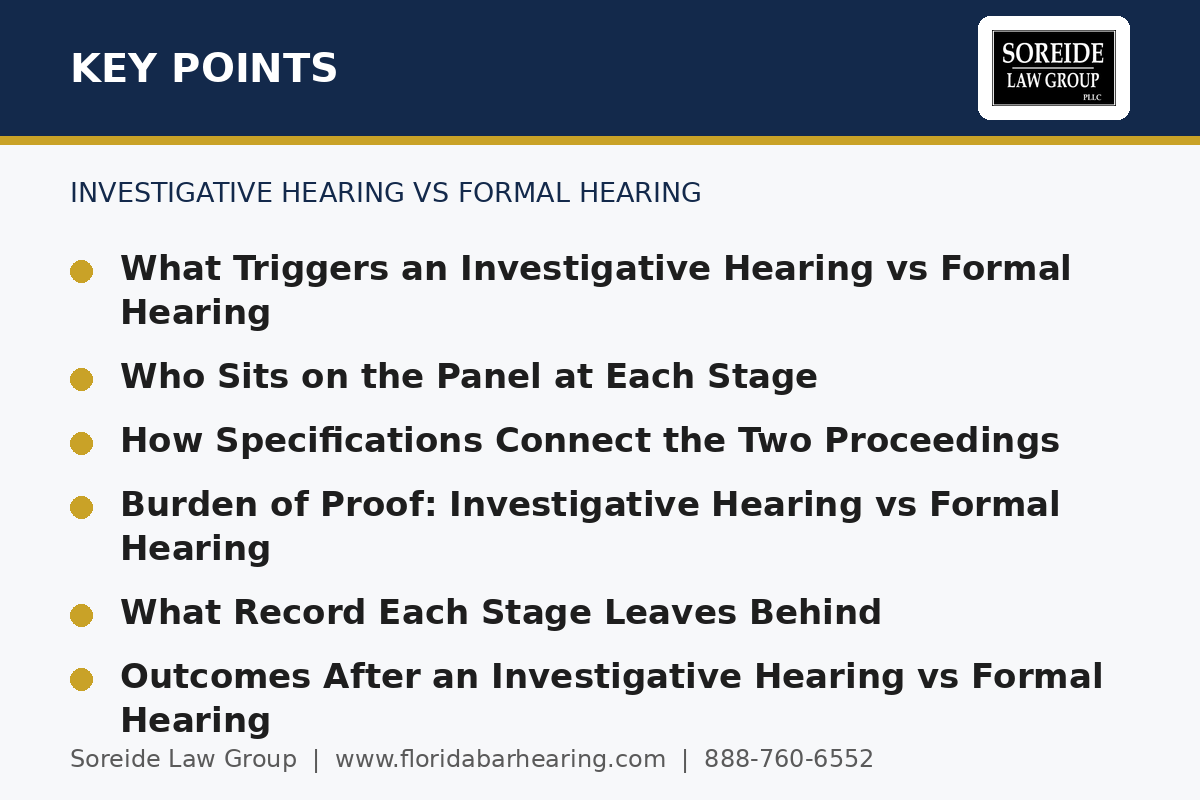
Investigative hearing vs formal hearing, key points: What Triggers an Investigative Hearing vs Formal Hearing; Who Sits on the Panel at Each Stage; How Specifications Connect the Two Proceedings; Burden of Proof: Investigative Hearing vs Formal Heari

What Triggers an Investigative Hearing vs Formal Hearing

Every application starts with a background investigation. Staff review what you disclosed, then check it against outside sources such as schools, employers and court records. Most of that work happens on paper. If a question stays open, the Board may ask you to appear and explain.

Common reasons include past arrests, nondisclosure on a bar or law school application, financial problems, and discipline in another state. So a notice does not mean the Board has decided anything. Instead, it means the Board has questions it wants to ask you in person.

The second stage has a higher threshold. It begins only when the Board has cause to believe you are not qualified, and it then files Specifications saying why. In short, the first stage asks a question, while the second makes a charge. Also, if the facts about prior conduct are undisputed, the Board may skip the first stage and move to a consent agreement or to Specifications.

Who Sits on the Panel at Each Stage

At the first stage, a division of at least three Board members hears you. The setting is informal, but it is thorough, because its purpose is to find the truth. Any member can place you under oath, and the technical rules of evidence do not have to be followed. You must also respond to the notice on time, since ignoring it can end your application.

At the second stage, the panel has at least five members. In addition, a member who took part in your earlier session cannot serve unless you consent. As a result, you will usually speak to people who have not heard your account before, so you cannot assume they know the background.

How Specifications Connect the Two Proceedings

Specifications are the bridge between an investigative hearing and a formal hearing. They are formal charges, written as allegations of misconduct or of a lack of character and fitness. For example, one might say that you failed to disclose an arrest on your application.

You must file a sworn answer within the time the Board’s rules set. If you do not answer, the charges are deemed admitted, and you give up the right to a hearing. So read each allegation closely, because the allegations frame everything that follows.

Not every case goes the full distance. Board counsel and an applicant may instead propose a consent judgment, which takes effect only if the full Board approves it.

Burden of Proof: Investigative Hearing vs Formal Hearing

At the first stage, nobody presents a case against you. Board members ask questions, and you supply answers, documents and context. However, the applicant must show good moral character and fitness to practice law throughout the process, so vague answers rarely help.

At the second stage, Board counsel presents the case, and the Board must prove its Specifications. You do not have to disprove them. Still, you must prove your own character and fitness. If past conduct is at issue, you should raise rehabilitation in your answer and support it with strong evidence. The post at Elements of Rehabilitation in a Formal Hearing explains what that proof can look like.

You also gain procedural rights at this stage. You may have a lawyer at your own expense, receive witness and exhibit lists, and cross-examine witnesses. You may then present your own witnesses and exhibits, and you may use the Board’s subpoena power.

What Record Each Stage Leaves Behind

The first stage is informal, but your words still matter. The Board’s rules refer to transcripts, so assume that what you say can be reviewed later. Also, an account that shifts between your application and your testimony can raise a new candor question.

The second stage is built around its record. The panel decides on the evidence in that record, and any written findings must be supported by competent, substantial evidence found there. That record is also what a reviewing court will read, so anything you want considered needs to go in at the hearing.

Outcomes After an Investigative Hearing vs Formal Hearing

After the first stage, the Board may find that you have established your qualifications. It may also offer a consent agreement in cases involving drug, alcohol or psychological problems, order further investigation, or file Specifications.

After the second stage, the Board may recommend admission or, in exceptional cases of those same kinds, conditional admission. It may instead recommend withholding admission for a period, or denial. A denial generally carries a waiting period before you can reapply. If the findings go against you, you may ask the Board to reconsider on new and material evidence, or you may petition the Supreme Court of Florida for review. Both paths have firm deadlines.

An investigative hearing can lead to a formal hearing, so prepare for the first as carefully as you would for the second. Review your application, gather your documents, and take responsibility for what happened. The post at Investigative Hearings before the Florida Bar covers that preparation in more detail.

Talk to a Florida Bar admission attorney

Soreide Law Group represents Florida Bar applicants before the Florida Board of Bar Examiners at investigative and formal hearings, and advises applicants on disclosure questions before they file. The firm is based in Pompano Beach, Florida and works with applicants statewide. Call 888-760-6552 or use the contact page to arrange a consultation.

The Florida Board of Bar Examiners publishes its admission rules and application materials at floridabarexam.org.

This article is general information about the Florida Bar admission process. It is not legal advice and does not create an attorney-client relationship. Every application is decided on its own facts.

https://www.floridabarhearing.com/wp-content/uploads/2026/11/investigative-hearing-vs-formal-hearing-florida-bar-featured.png 675 1200 Soreide Law Group https://www.floridabarhearing.com/wp-content/uploads/2015/10/soreide-logo-300x183.png Soreide Law Group2026-11-06 07:59:002026-11-06 07:59:00Investigative Hearing vs Formal Hearing Before the Florida Board of Bar Examiners

The Character and Fitness Categories the Florida Board of Bar Examiners Reviews

November 1, 2026

Every Florida Bar application goes through a character and fitness review before the applicant can be admitted. The Florida Board of Bar Examiners does not ask one broad question about character. It asks a long series of specific questions grouped into categories, and its staff verify the answers against outside records. Knowing what those categories are, and why the Board asks about each one, takes much of the mystery out of the application.

This post walks through the main categories the Board reviews, what the application asks in each, how the staff check the answers, and what in each area tends to lead to a request for more information or an investigative hearing. It is general information about the process, not advice about any particular application.

Why the Board reviews character and fitness at all

Admission to the Florida Bar requires more than passing the examination. The Board is charged with determining whether each applicant has the character and fitness to practice law, and it does that by investigating the applicant’s history and conduct. The categories below are the areas the Board’s rules identify as relevant to that determination.

The investigation starts with the applicant’s own answers. Staff then obtain records from courts, schools, employers, credit bureaus, licensing bodies and other sources, and compare them with what the applicant disclosed. Where the records and the answers match and nothing of concern appears, the review closes on paper. Where there is a gap, a pattern, or a serious event, the Board may ask for more information or invite the applicant to an investigative hearing.

Criminal history and law enforcement contacts

The application asks about arrests, charges, convictions, citations beyond minor traffic matters, and other contacts with law enforcement, including matters that were dismissed, sealed or expunged. The Board is interested in the conduct itself, how long ago it happened, what has happened since, and whether the applicant disclosed it fully.

A single old event that was disclosed completely and explained candidly is treated very differently from a pattern of similar events or a recent matter. The question the Board returns to is whether the conduct, taken with everything else in the file, says something about how the applicant will handle the responsibilities of a lawyer.

Academic and professional conduct

The Board asks about discipline at any school attended, honor code proceedings, academic dismissals, and findings of plagiarism or cheating. It also obtains the dean’s certification from the law school and compares the law school application with the Bar application. A mismatch between the two is one of the most common reasons an applicant hears from the Board.

Professional conduct covers prior licenses in any field, discipline by a licensing body, and for out-of-state attorneys, grievances, malpractice claims and trust account problems in another jurisdiction. Candor about these matters carries as much weight as the matters themselves.

Financial responsibility

The application asks about debts in default, judgments, liens, collections, bankruptcies and unpaid taxes or child support. The Board is not looking for wealth. It is looking at whether the applicant has met financial obligations or made reasonable arrangements to do so, because lawyers hold client funds and must handle them responsibly.

Documentation matters in this area more than in most. A payment plan in writing, proof of settlement, or a letter confirming that an account has been brought current can resolve a question that the raw credit report alone would leave open. Our earlier post at /bar-applicants-in-financial-trouble/ covers this category in more depth.

Substance use, mental health and conditional admission

The application asks about treatment and conduct related to alcohol and drugs, and about mental health conditions only to the extent they bear on the applicant’s current fitness to practice. The Board’s interest is in present fitness and in whether any condition is being managed, not in a diagnosis for its own sake.

Where there is a history in this area, the Board may consider conditional admission, under which the applicant is admitted subject to monitoring for a period of time, often through Florida Lawyers Assistance. Applicants with questions about how this works can read /florida-lawyers-assistance/ and the Board’s own published materials.

Employment history and candor

The application asks for a complete employment history and whether the applicant was ever terminated, asked to resign, or left a job while under investigation. Staff may contact former employers. As with every other category, the Board compares what the applicant reported with what the records show.

Candor runs through all of the categories above. An omission or an answer that minimizes an event is weighed separately from the underlying conduct, and it is often the omission rather than the event that leads to an investigative hearing. Applicants who are unsure whether something must be disclosed are generally better served by disclosing it and explaining it. Soreide Law Group regularly advises applicants on disclosure questions before an application is filed and represents them if the Board schedules a hearing.

Talk to a Florida Bar admission attorney

Soreide Law Group represents Florida Bar applicants before the Florida Board of Bar Examiners at investigative and formal hearings, and advises applicants on disclosure questions before they file. The firm is based in Pompano Beach, Florida and works with applicants statewide. Call 888-760-6552 or use the contact page to arrange a consultation.

This article is general information about the Florida Bar admission process. It is not legal advice and does not create an attorney-client relationship. Every application is decided on its own facts.

https://www.floridabarhearing.com/wp-content/uploads/2015/10/soreide-logo-300x183.png 0 0 Soreide Law Group https://www.floridabarhearing.com/wp-content/uploads/2015/10/soreide-logo-300x183.png Soreide Law Group2026-11-01 01:41:412026-10-31 01:42:32The Character and Fitness Categories the Florida Board of Bar Examiners Reviews
Article graphic: Investigative Hearings Before the Florida Bar, Soreide Law Group

Can Trust Account Errors Lead to Florida Bar Discipline?

August 10, 2026
Read more
https://www.floridabarhearing.com/wp-content/uploads/2026/07/investigative-hearings-florida-bar-featured.jpg 630 1200 Editor https://www.floridabarhearing.com/wp-content/uploads/2015/10/soreide-logo-300x183.png Editor2026-08-10 16:29:532026-08-10 16:31:24Can Trust Account Errors Lead to Florida Bar Discipline?

Florida Bar Application Updates

August 3, 2026

Soreide Law Group knows that it can be a very stressful time waiting and wondering about your Florida Bar application.  If it is still pending, to help assist you in gathering information, you are able to download it directly from the Applicant Portal.

These are the steps to walk you through the process:

1. Log into the Florida Board of Bar Examiners Applicant Portal.
2. When you get to the portal home page, look for “Review Finalized Bar Application” (or Display Finalized Bar Application, depending on what stage your application is at the time.)
3. Click on the link.
4. Your Florida Bar application will open as a PDF. You can download it or print it using your PDF controls.

If you can’t see “Review Finalized Bar Application” or “Display Finalized Bar Application” link, it may be because your application is still pending, or you have been admitted to the Florida Bar.

If you’ve already been admitted and your application was less than 5 years ago: you can request a copy from the Board by submitting a Bar Application Request Form and paying the fee.  If it was more than 5 years ago, the Board no longer maintains a copy of your
application.

We recommend you always checking with the Florida Board of Bar Examiners for the most current information.

Soreide Law Group is based in Pompano Beach, Florida. We represent applicants in both investigative and formal hearings before the Florida Board of Bar Examiners. If you have an upcoming investigative hearing or a formal hearing, please call Soreide Law Group and speak to an experienced license defense attorney at no cost to you at: 888-760-6552.

https://www.floridabarhearing.com/wp-content/uploads/2015/10/soreide-logo-300x183.png 0 0 Editor https://www.floridabarhearing.com/wp-content/uploads/2015/10/soreide-logo-300x183.png Editor2026-08-03 18:23:292026-08-03 18:23:29Florida Bar Application Updates

FLORIDA BAR HEARING DATES for 2027

June 16, 2026

The Florida Board of Bar Examiners’ meeting dates with hearing locations are listed below for 2027. Please note that some of the dates will be held via Zoom and the other locations will be held in person.  Please note it is possible for these dates, times and locations to change.

Soreide Law Group, located in Pompano Beach, Florida, has represented hundreds of applicants for both investigative and formal hearings before the Florida Board of Bar Examiners. If you are contacted by the Florida Board of Bar Examiners requesting an investigative or formal bar hearing, you should be prepared for their hearing.

The dates, locations, and sleeping room rate the board has secured at each location (where applicable) follow:


January 22-23, 2027                                    Orlando                                                    $269

March 11-12, 2027                                        via Zoom

April 9, 2027                                                 Tallahassee                                               $249

May 13-14, 2027                                           via Zoom

July 15, 2027                                                 via Zoom

August 20-21, 2027                                     Coral Gables                                              $199

September 9-10, 2027                                via Zoom

October 15-16, 2027                                     West Palm Beach                                     $199

November 19-20, 2027                               Tampa                                                         $229

If you feel you may not be ready for your Florida Board of Bar Examiners bar hearing or if you feel it is short notice, then we would recommend you wait until you are fully prepared and have done all of the work in advance.  You should not rush into an earlier hearing if you are not ready. If you are not sure, we recommend you contact an attorney for a consultation.

Every bar hearing requires evidence and testimony which is tailored to your specific fact set. Many of these items can be obtained quickly, however, it will vary case by case. The Board will waive the 15-day rule for submitting your evidence in advance if you are within the 15-day window. In this case, you would be able to bring your exhibits with you to the hearing itself. You must bring 5 copies of whatever needs to be submitted, which includes, one copy for each of the Board members, one for the record, and one for you.

Soreide Law Group is conveniently based in Pompano Beach, Florida, and we travel to every bar hearing location in Florida representing applicants in both investigative and formal hearings before the Florida Board of Bar Examiners. If you have an upcoming investigative hearing or a formal hearing call Soreide Law Group and speak to an experienced license defense attorney at no cost to you at: 888-760-6552.

https://www.floridabarhearing.com/wp-content/uploads/2015/10/soreide-logo-300x183.png 0 0 Editor https://www.floridabarhearing.com/wp-content/uploads/2015/10/soreide-logo-300x183.png Editor2026-06-16 21:00:272026-06-16 21:00:27FLORIDA BAR HEARING DATES for 2027

FLORIDA BAR HEARING DATES for 2026

October 6, 2025

The Florida Board of Bar Examiners’ meeting dates with hearing locations are listed below for 2026. Please note that some of the dates will be held via Zoom and the other locations will be held in person.

Soreide Law Group, is conveniently located in Pompano Beach, Florida, and has represented hundreds of applicants for both investigative and formal hearings before the Florida Board of Bar Examiners. If you are contacted by the Florida Board of Bar Examiners requesting an investigative or formal bar hearing, you should be prepared for their hearing.


January 23-24, 2026                  Orlando

March 12-13, 2026                     via Zoom

April 17,  2026                               Tallahassee

May 14-15, 2026                          via Zoom

July 9-10, 2026                              via Zoom

August 21-22, 2026                    Orlando

September 24-25, 2026          via Zoom

October 23-24, 2026                Ft. Lauderdale

November 20-21, 2026           Orlando


Soreide Law Group reminds you that every bar hearing requires evidence and testimony which is tailored to your specific fact set. Many of these items can be obtained quickly, however, they can vary case by case. If you feel you may not be ready for your Florida Board of Bar Examiners bar hearing, then we recommend you wait until you are fully prepared and have done all of the work in advance.  You should not rush into an earlier hearing if you are not prepared. If you are not sure, we recommend you contact an attorney for a consultation.

Soreide Law Group is based in Pompano Beach, Florida. We travel to every bar hearing location in the state of Florida representing applicants in both investigative and formal hearings before the Florida Board of Bar Examiners.

If you have received a notice requesting an investigative hearing or a formal hearing please call Soreide Law Group and speak to an experienced license defense attorney at no cost to you at: 888-760-6552.

https://www.floridabarhearing.com/wp-content/uploads/2015/10/soreide-logo-300x183.png 0 0 Editor https://www.floridabarhearing.com/wp-content/uploads/2015/10/soreide-logo-300x183.png Editor2025-10-06 15:48:122025-10-06 15:48:12FLORIDA BAR HEARING DATES for 2026

Florida Bar Hearing Dates for 2025

October 17, 2024

Soreide Law Group, conveniently located in South Florida, has represented hundreds of applicants for both investigative and formal hearings before the Florida Board of Bar Examiners. If you are contacted by the Florida Board of Bar Examiners requesting an investigative or formal bar hearing, you should be prepared for their hearing.

The following dates were recently released by the Florida Board of Bar Examiners for their upcoming bar hearing meeting dates for 2025. Please note that some of the dates will be held via Zoom and others will be held in person.

January 24 – 25, 2025             Tampa

March 20 – 21, 2025                 Via Zoom

April 11, 2025                             Tallahassee

May 15 – 16, 2025                     Via Zoom

July 11 – 12, 2025                      Coral Gables

September 11 – 12, 2025         Via Zoom

October 17 – 18, 2025              Jacksonville

November 14 – 15, 2025         Orlando

Every bar hearing requires evidence and testimony which is tailored to your specific fact set. Many of these items can be obtained quickly, however, it will vary case by case. The Board will waive the 15 day rule for submitting your evidence in advance if you are within the 15 day window. In this case, you would be able to bring your exhibits with you to the hearing itself. You must bring 5 copies of whatever needs to be submitted, which includes, one copy for each of the Board members, one for the record, and one for you.

If you feel you may not be ready for your Florida Board of Bar Examiners bar, then we recommend you wait until you are fully prepared and have done all of the work in advance.  You should not rush into an earlier hearing if you are not ready. If you are not sure, we recommend you contact an attorney for a consultation.

Soreide Law Group is based in Pompano Beach, Florida. We travel to every bar hearing location in Florida representing applicants in both investigative and formal hearings before the Florida Board of Bar Examiners. If you have an upcoming investigative hearing or a formal hearing please call Soreide Law Group and speak to an experienced license defense attorney at no cost to you at: 888-760-6552.


https://www.floridabarhearing.com/wp-content/uploads/2015/10/soreide-logo-300x183.png 0 0 Editor https://www.floridabarhearing.com/wp-content/uploads/2015/10/soreide-logo-300x183.png Editor2024-10-17 13:10:552024-10-17 13:10:55Florida Bar Hearing Dates for 2025
Social media Florida Board of Bar Examiners

2024 Dates for Florida Bar Hearings

October 3, 2023

Soreide Law Group has represented hundreds of applicants for both investigative and formal hearings before the Florida Board of Bar Examiners. If a bar applicant is contacted by the Florida Board of Bar Examiners requesting an investigative or formal bar hearing, the applicant must be prepared for their hearing.

The following dates were recently released by the Florida Board of Bar Examiners for their upcoming bar hearing meeting dates in 2024. Please note that some of the dates will be held via Zoom and others will be held in person.

JANUARY 25-26, 2024                                  VIA ZOOM

MARCH 22, 2024                                           TALLAHASSEE

APRIL 18-19, 2024                                         VIA ZOOM

MAY 17-18, 2024                                            HOLLYWOOD

JUNE 27-28, 2024                                          VIA ZOOM

AUGUST 24-25, 2024                                    TAMPA

SEPTMEBER 19-20, 2024                            VIA ZOOM

OCTOBER 18-19, 2024                                  CORAL GABLES

NOVEMBER 15-16, 2024                              ORLANDO

Each bar hearing requires evidence and testimony which is tailored to your specific fact set. Many of these items can be obtained quickly however, it will vary case by case. The Board will waive the 15 day rule for submitting your evidence in advance if you are within the 15 day window. In this case, you would be able to bring your exhibits with you to the hearing itself. You must bring 5 copies of whatever needs to be submitted, which includes, one copy for each of the Board members, one for the record, and one for you.

If you feel you may not be ready for your Florida Board of Bar Examiners bar hearing or if you feel it is short notice, then we would recommend you wait until you are fully prepared and have done all of the work in advance.  You should not rush into an earlier hearing if you are not ready. If you are not sure, we recommend you contact an attorney for a consultation.

Soreide Law Group is conveniently based in Pompano Beach, Florida. We travel to every bar hearing location in Florida representing applicants in both investigative and formal hearings before the Florida Board of Bar Examiners. If you have an upcoming investigative hearing or a formal hearing please call Soreide Law Group and speak to an experienced license defense attorney at no cost to you at: 888-760-6552.


https://www.floridabarhearing.com/wp-content/uploads/2013/04/bg-10.jpg 665 1000 Editor https://www.floridabarhearing.com/wp-content/uploads/2015/10/soreide-logo-300x183.png Editor2023-10-03 19:11:212023-10-03 19:11:212024 Dates for Florida Bar Hearings

Applicants Before Florida Bar Examiners Should Write a Brief

January 26, 2023

As an experienced Florida Bar Hearing Defense Attorney, I know that after ever investigative hearing before the Florida Board of Bar Examiners, there can be a range of outcomes. The worst outcome is the filing of specifications and the applicant having to advance to a formal hearing before the board. When the conduct is bad but not quite egregious enough to warrant a hearing that takes up the board’s time and resources, they can ask you to do anything from community service to writing a brief. The brief would be on a topic that is relevant to your specific perceived misconduct.  I’ve seen topics ranging from candor to financial responsibility. For example, after a complex hearing with multiple issues spanning decades, one of the last clients I represented before the board was given an opportunity to write a brief in lieu of specifications being filed.

The board requested the following (some is redacted to protect client privacy):

“The board requires a 20-page brief, double-spaced and 14 point Arial font, prepared by your client, signed, and filed with the board. The brief must conclude with a declaration stating: “Under penalties of perjury, I declare that I have read the foregoing brief, that the facts stated in it are true, and that the work in this brief is my own.”

The brief should address your client’s understanding of candor, including discussions specifically about candor to tribunals, such as the board of bar examiners, and as it relates to the following: (1) your client’s own past behavior as it relates to failure to disclose on the law school application, arrests for driving under the influence, and charges for driving with a suspended license, (2) the practice of law and the obligation of an attorney to tell the truth, (3) the Rules of the Supreme Court Relating to Admissions to the Bar and the need for candor by bar applicants and the Rules Regulating The Florida Bar on the need for candor in communicating with clients and courts, including citations and explanations of applicable judicial decisions interpreting those rules.

The brief must be received within 30 days from the date of this letter. If your client is not interested in filing a brief, notify the board in writing. If additional time is needed to submit the brief, request an extension of time in writing before the expiration of the deadline. If neither an extension request nor a brief is received within 30 days of the date of this letter, the board will proceed with final consideration of the bar application based on the record currently before it, which may include termination of the application.”

In this circumstance my advice would be to take the offer, write the brief, and become a lawyer. However, an experienced attorney will be able to anticipate what the issues are that the Board of Bar Examiners are concerned with that relate to your character and your specific situation. We can have you do this in advance to show the board you already know what is expected and required of you as an attorney. This saves the applicant time and promotes goodwill with the board and shows them that you possess the requisite good character and fitness today as you appear before them to be admitted to the Florida Bar. For more information or questions on formal or informal character hearings before the Florida Board of Bar Examiners call Soreide Law Group at 888-760-6552.

https://www.floridabarhearing.com/wp-content/uploads/2015/10/court-gavel-1.jpg 0 0 Editor https://www.floridabarhearing.com/wp-content/uploads/2015/10/soreide-logo-300x183.png Editor2023-01-26 19:12:182023-01-26 23:13:24Applicants Before Florida Bar Examiners Should Write a Brief
Page 1 of 12123›»
Search Search

Recent Posts

  • Florida Lawyers Assistance Is Closing: Why The Florida Bar Ended Its Funding and What Replaces It
  • Investigative Hearing vs Formal Hearing Before the Florida Board of Bar Examiners
  • The Character and Fitness Categories the Florida Board of Bar Examiners Reviews
  • Can Trust Account Errors Lead to Florida Bar Discipline?
  • Florida Bar Application Updates

Archives

  • November 2026
  • August 2026
  • June 2026
  • October 2025
  • October 2024
  • October 2023
  • January 2023
  • October 2022
  • August 2022
  • March 2022
  • September 2021
  • June 2021
  • March 2021
  • December 2019
  • September 2019
  • May 2019
  • April 2019
  • September 2018
  • March 2018
  • August 2017
  • June 2017
  • July 2016
  • June 2016
  • April 2016
  • March 2016
  • February 2016
  • August 2015
  • July 2015
  • June 2015
  • January 2015
  • November 2014
  • October 2014
  • September 2014
  • August 2014
  • July 2014
  • June 2014
  • May 2014
  • April 2014
  • March 2014
  • February 2014
  • January 2014
  • December 2013
  • September 2013
  • August 2013
  • April 2013
  • February 2013
  • December 2012
  • November 2012
  • October 2012
  • August 2012
  • June 2012
  • April 2012
  • February 2012
  • October 2011
  • July 2011
  • June 2011
  • May 2011
  • April 2011
  • March 2011
  • February 2011
  • January 2011
  • December 2010
  • October 2010
  • September 2010
  • August 2010
  • July 2010
  • June 2010
  • May 2010
  • April 2010
  • March 2010

Business Hours

  • Monday-Friday: 9am to 5pm
  • Saturday: 10am to 2pm
  • Sunday: Closed

Our phone numbers are available 24hs for any consultation you may have.

Contact Us

2401 E. Atlantic Blvd
Suite 305
Pompano Beach, FL 33062
Toll Free: (888) 760-6552
Local: (954) 760-6552
Fax: (954) 760-6553
Email: [email protected]

About Us

We Represent Florida Bar Attorneys and Florida Bar Applicants Before The Florida Bar Grievance Committee and the Florida Board of Bar Examiners

Where you can find us

Copyright © 2026, SOREIDE LAW GROUP PLLC
Scroll to top Scroll to top Scroll to top